
As our Greek Islands Cruise Tour, which we had planned months in advance, was approaching, the only topic we were researching like crazy was: Greek Wines! The wines we had recently had the chance to taste in both Drama and Chios had gotten us more than excited for our trip.
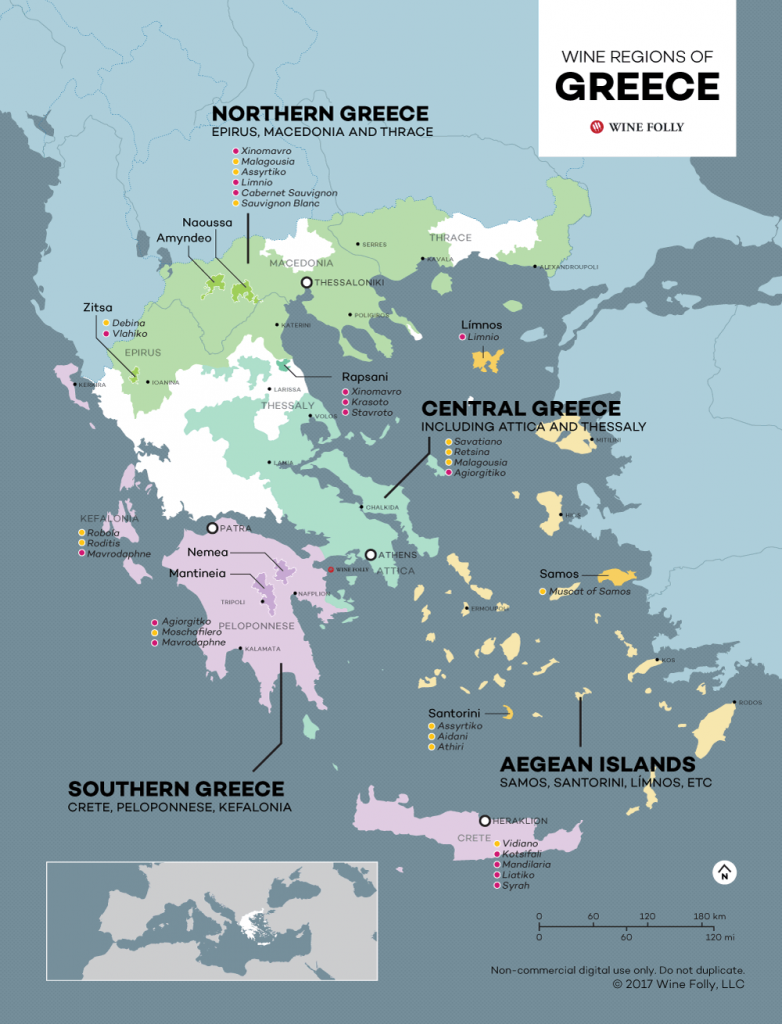
Source: https://winefolly.com/deep-dive/the-wine-regions-of-greece-map/
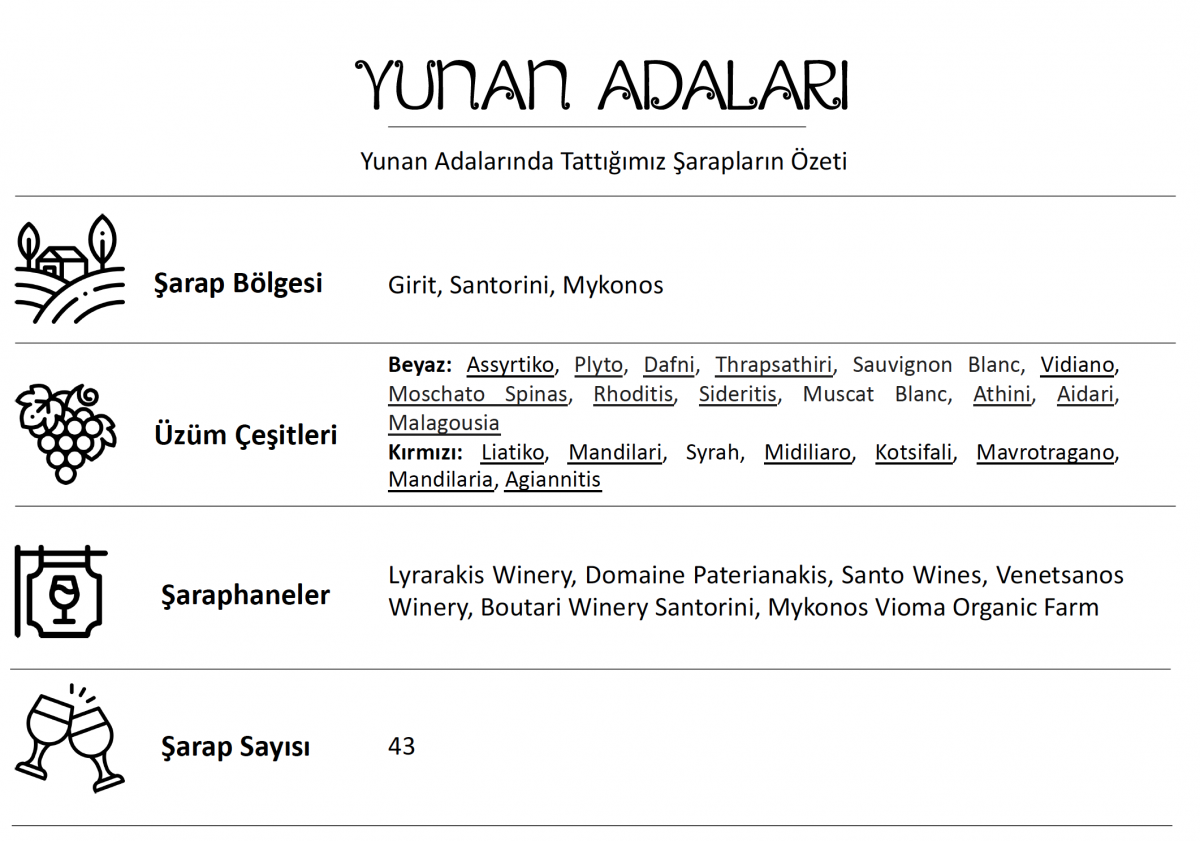
Our only problem was choosing which wineries to visit in our limited time, especially since Crete and Santorini had a great number of wineries. Based on criteria such as accessibility to the ship and tourist areas, quality, and proximity to other wineries, we decided to visit 2 wineries in Crete and 3 in Santorini. The Mykonos and Milos parts turned out to be full of surprises, both positive and negative 🙂
Notes we took about the wineries we had the chance to visit and other touristic points of interest (click to add to Google Maps):
Crete
Crete, with its 8,450 km2 surface area, is the largest island of Greece. Standing out with its olive trees, vineyards, rich cuisine and turquoise coves, one day is definitely not enough for this island. That is why we only focused on the wines of the island. Ships also dock at the port of Heraklion, the capital of this island. Unfortunately, there are no wineries in this small city, which can be covered in 1 to 2 hours in terms of touristic and historical sightseeing. You need to drive 20 to 30 minutes to get to the nearest winery. Since public transportation is not very common in these areas, it is possible to resort to solutions like car rental or taxis. Since our time in Crete was limited, after some hard bargaining with a taxi driver, we agreed on him accompanying us for the whole day for 100 EUR.

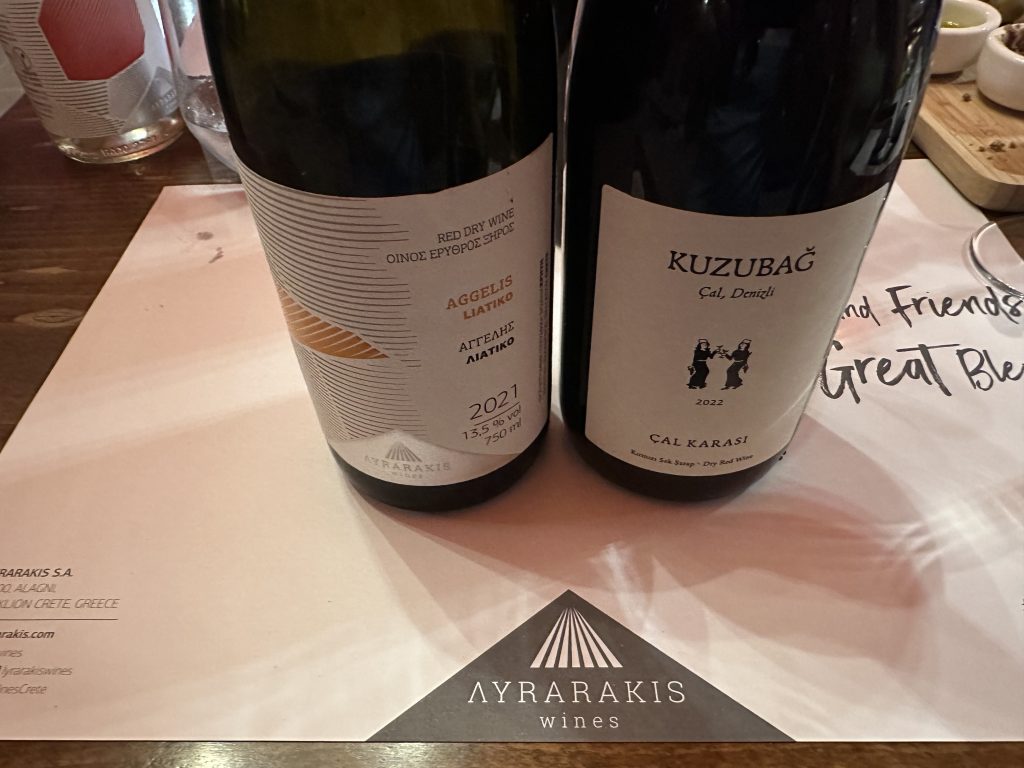
Lyrarakis Winery: They have an online menu on their own website, with both tasting and price details for all the different options. You can also make an online reservation, but if you show up at the door, they can also accommodate you depending on availability. As a couple, we shared the 7 wine tasting. Their single glass pour ratios are more than 5 cl, so it is more than enough. The staff are very warm, the atmosphere is quite pleasant, and the wines are truly very original. Lyrarakis saved two different white grapes called Plyto and Dafni from extinction, and they currently produce both as single varietals. Dafni in particular has a very unique flavor; you might suddenly feel like you are drinking a basil and rosemary essence. Their overall wine flavor performance is very good, and it is definitely worth stopping by if you are in the area. When we mentioned that we prefer red wine more, they swapped a sparkling wine, which was the 7th wine of the tasting, for a different red wine. As our conversation with the team got deeper and they asked where we were from, upon hearing the answer Turkey, they immediately brought out Kuzubag's Calkarasi wine 🙂 We had the chance to have a very enjoyable and informative conversation about the shared grape Liatiko/Calkarasi. We can say it was one of the places we were most satisfied with throughout our entire trip.
Domaine Paterianakis: Just like Lyrarakis, this place also has an online menu on their own website, with both tasting and price details for all the different options. You can also make an online reservation. It was relatively less crowded compared to Lyrarakis, so you do not need to make an online reservation for this one.
One of the biggest features of Paterianakis is that they practice organic farming. Before the tasting, they bring various herbs piece by piece (thyme, rosemary, mint) and specifically have you smell them and ask you questions, so you can understand how much of these you pick up in the wines. They say that since there are a lot of bees in the area, these aromas transfer heavily into their wines. And indeed, especially in the first Thrapsathiri and Sauvignon Blanc blend we tasted, we pick up these aromas intensely.
Paterianakis's white wines are truly very good. We especially liked their Moschato Spinas, a local grape from the Muscat family, so much that we bought some to take with us. In addition to the classic aromatic spring flowers and tropical fruits, it is possible to feel the aroma harmony of the thyme, rosemary and mint flowers found in the region in every sip. We also did not miss tasting the grape raki made from various grapes that was offered as a complimentary pour 🙂 Their reds, however, still have some way to go. You can make your choices from the whites.
Santorini
Santorini's settlements are positioned 400 m above sea level. This island, formed as a result of a massive volcanic eruption 500 years ago, has incredible views. The wineries have also made the most of these views 🙂 Some wineries in particular have become a stop even for tourists who have no interest in wine at all, purely because of the scenery. This was the route we had the hardest time with since there were so many quality options. Due to ease of access, we decided to go with the 3 highest rated producers in the Pyrgos area. Santorini, like Crete, is an island lacking public transportation. If you are not renting a car, you are at the mercy of taxi drivers. Because of this, choosing producers within walking distance of each other can turn into an extra advantage for car free travelers. The fact that the roads are not suitable for bicycles also significantly limits transportation alternatives.
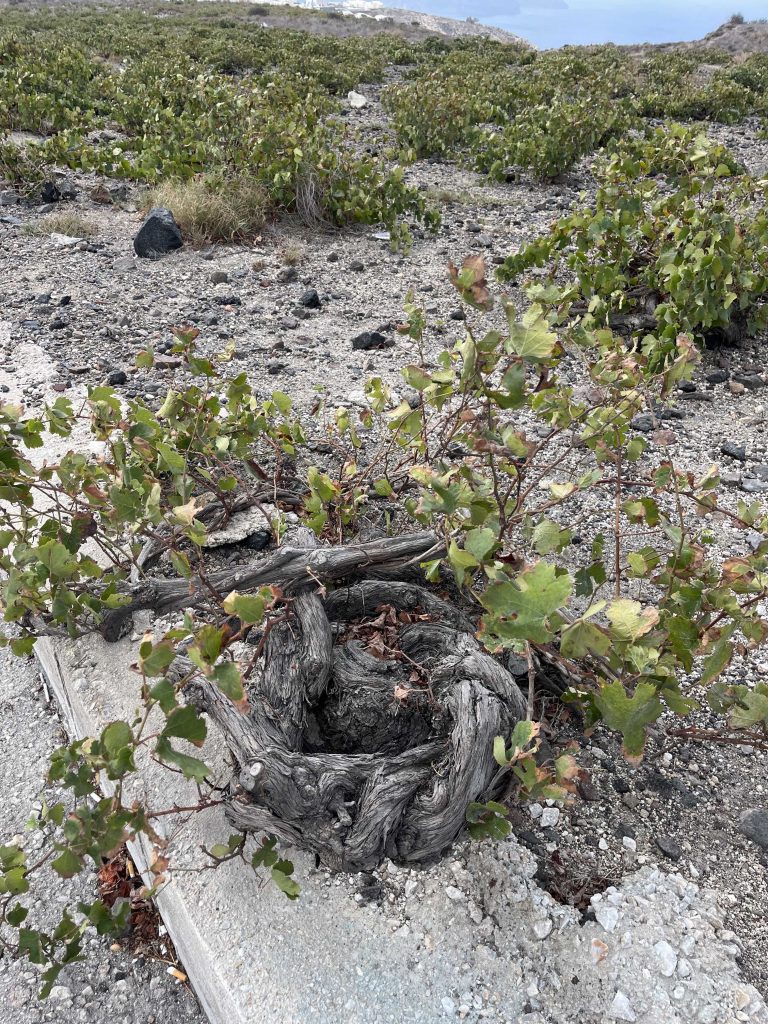
The most original aspect of Santorini regarding wine is definitely the shape of its vines. Since the island receives very strong winds year round, they shape the vines into a ring form from the very first moment of growth so they are better protected. This creates a very beautiful vine appearance. The name of this special method is Kouloura.
Santo Wines: They have tasting menus with different contents in sets of 4, 5, 6, and 8, allowing you to choose one according to your preferences. Since we wanted to taste their higher tier wines, we got the 5 wine premium set for 35 EUR and shared it as a couple. Since they pour generously, one tasting set was enough for a couple. Santo, one of the oldest wineries on the island, definitely has an enchanting view. Even if we were not satisfied with the wines, it would still be a place we would definitely recommend, and the premium tasting set did satisfy us. At this winery where we had the chance to taste 3 different Assyrtiko wines, 1 red, and 1 Vinsanto (a sweet wine unique to Santorini made from Assyrtiko), we were more than surprised by the Assyrtiko wines in particular. We found the Santorini Assyrtikos, which we expected to be more mineral due to the soil structure, to be much more acidic and less mineral compared to Crete. The fact that such beautifully full bodied wines are being made from a local white grape absolutely delighted us.

Venetsanos Winery: Venetsanos, a cave style winery, is located within a 10 to 15 minute walking distance from Santo Winery. Although the walking path is not very comfortable, the views are absolutely spectacular. Santorini in general is designed around car transportation. We still preferred to walk.
This place was a bit more expensive compared to Santo Wines. Tasting sets were 32 EUR for the 4 wine set, 39 for the 6 wine set, and 41 EUR for the 6 wine sweet wine version. Although we found 3 of the 4 wines we drank to be average, we found the rose wine made from the local grapes Assyrtiko (white) and Mandilari (red) to be very original. The blend of grapes of different colors, which we first encountered in France with Viognier and Syrah grapes, earned a passing grade from us in Greece as well, with the selection of 2 very harmonious and balancing grape varieties.
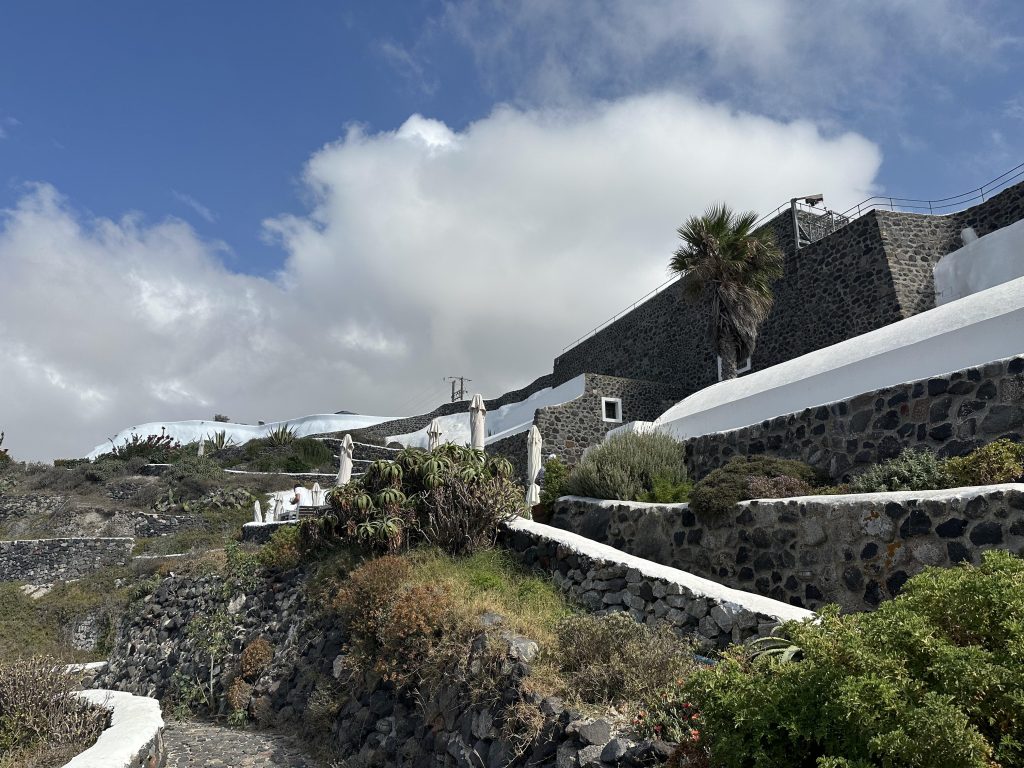

Boutari Winery: This producer, which has wineries in 6 different regions across Greece, stands out at its Santorini branch with its award winning architectural design. At this producer where you can also taste wines produced in different regions alongside the Santorini terroir in their tasting menu, the wine quality is what truly sets them apart.
There are different tasting prices available; the 4 wine set is 20 EUR, the 6 wine premium set is 28 EUR, and we went with the 6 wine set. You can choose the ones you want to taste from among 9 wines. We went without a reservation, and they accepted us since there was availability, but we can say we got a bit of a lecture from the tasting lady about how lucky we were 🙂 If you have the chance, we recommend going with a reservation.
In terms of overall value for money, Boutari was the place where we found the wines most successful. Although not from this region, the 2017 vintage wine called 1879 Boutari Legacy from the Naoussa region, which we had the chance to taste, entered our notes as one of the most successful reds we have had in recent years. If you are in the area, this will definitely be the place we recommend most.
Mykonos
Finding two wine producers on this island, famous for its nightlife in Greece, was one of the best surprises of our trip. On this island where no winery showed up in our Google searches, it turns out there are 2 places producing under the name of farm. We had the chance to visit a producer that practices biodynamic farming. The transportation problem we experienced on other Greek Islands was also present here, and we were only able to reach the winery by arranging a taxi.
Mykonos Vioma Organic Farm: Vioma is a quite humble producer. It was established on a vineyard area that formerly belonged to a monastery but was later abandoned. They utilized biodynamic farming methods to bring the vineyard to its current state. To protect themselves from the island's never ending winds, they used bamboo trees planted around the vineyard. Before going, you can make a reservation for both wine tasting and a winery and vineyard tour through their website. The 20 euro fee includes 4 wines and a vineyard tour. Being a quite different winery where you can only taste local Greek grapes, it definitely added color to our Mykonos visit.
Milos
Milos was an island where we found peace, giving the feel of a quiet fishing town. The excessive tourist crowds of other islands are absent on this one. Therefore, it is an island built around a more relaxed time and a beach holiday.
Milos is home to 1 winery. However, unlike the usual tasting hours, the tasting hours were between 5 PM and 9 PM. Since these hours did not fit our cruise schedule, unfortunately we did not get the chance to visit and taste. Let us leave below some information about this winery, which you can reach by taxi from the town center for 30 euros.
Kostantakis Winery: Kostantakis Winery, the oldest and still the only active winery established in Milos, continues production with its 3rd generation. You can find information about this cave style winery, designed to take advantage of the volcanic soil structure, and its tasting menu on their website. The winery also offers accommodation options.
Unfortunately, it was also not possible to access the by the glass wines of this winery, whose tasting we could not do, at different venues. After asking at least 10 to 15 different venues with no luck, we bought their wines from a wine shop in central Milos to try at home. Having had the chance to taste 3 different wines of this winery at home, we found their products to be average overall.

General Comments and Notes
- It is believed that the Liatiko grape and the grape we know as Calkarasi are the same, only their names have been localized to their respective regions. We quite liked the red Liatiko made from old vines that we drank at Lyrarakis, but its overall structure was quite different from the Calkarasi examples we have had in Turkey.
- Mandilari is a grape with a lot of promise. Quality versions should be tasted in many different regions.
- Overall, all producers have embraced their local grapes. The number of international grape varieties we tasted was very few. There is a lot we can learn from as a country 🙂
- Interestingly, the Assyrtiko wines we drank in Crete were more mineral than the ones we drank in Santorini. The Santorini Assyrtikos were much more acidic. While on paper we would have expected the opposite, this experience surprised us a bit.
- The rose wine made from a blend of Mandilari and Assyrtiko impressed us quite a lot. It is worth trying similar works coming from the region.
- Santorini's reds did not appeal to us very much. They are good with whites and roses, but to enjoy their reds, you need to get used to their different styles a bit.
- Although not from these islands, among the other wines we drank during our trip, our favorite white grape was Malagousia, and for reds it was Xinomavro from the Naoussa Region. The same grapes from different regions should be tasted in abundance whenever encountered. We quite liked Xinomavro both as a rose and as a red.
- Vinsanto wines are a very nice alternative for those who love sweet wines. As a couple who does not prefer sweet wines very much, we liked all the Vinsantos we drank. We found the flavors of the aged versions to be much more settled. We especially loved a 2002 vintage Vinsanto we drank. Older vintages should be sought out and tried whenever possible.
- Vinsanto is apparently an abbreviation of Wine of Santorini. We noted this as a nice piece of additional information.
- On the island of Crete, every family apparently has their own amount of olive trees, and everyone living on the island has their olive oil pressed from their own olives. The boutique olive oil factory Kleanthi, which we had the chance to visit during our trip, produces its own olive oil and also helps people press the olives they bring in. If you want to try Cretan olive oils, you can stop by; it is on the wine route.
Favorite Wines
Since we had the chance to drink many wines both from within the region and from different regions during our Greece trip, we decided to make 2 separate lists, one for the region and one for outside.
Crete, Santorini, Mykonos, Milos:
- Boutari, Vinsanto (12 years aged), Assyrtiko, Aidani, 2002, White/Sweet, Greece, Santorini: Nose has magnificent caramel, honey, sweet aromas, vanilla, dried tobacco; palate is lightly acidic and rich on the palate. A wonderful wine. 7.5/10
- Domaine Paterianakis, Moschato Spinas, 2022, White, Greece, Crete: Spring flowers, honeysuckle, jasmine on the nose. Same flavors on the palate. It has an oily texture on the palate, quite full. The combination of acidity and fullness adds a nice dimension. Long finish. A very aromatic, beautiful white wine. 7.5/10
- Boutari, Kallisti Reserve, Assyrtiko, 2020, White, Greece, Santorini: Nose is extremely mineral, with fresh hazelnut and smoky vanilla aromas from the oak; palate is very smooth, then acidity comes through. The harmony of acidity with the wine's complexity works well; the acidity does not overpower. Nice complexity, oily, long finish, with a sweet minerality as well. It was the most successful Assyrtiko we drank during the trip. 7.4/10
- Lyrarakis, Plakoura Vineyard, Mandilari, 2018, Red, Greece, Crete: Oak is felt on the nose. Ripe cherry, some dark fruits, a bit of spice. High acidity, tannins are strong on the palate but not angular. Could be magnificent after 10 more years of aging. 7.3/10
- Venetsanos, Anagallis, Mandilaria, Assyrtiko, Aidani, 2022, Rose, Greece, Santorini: Peach, strawberry, various fruits on the nose, rich. Same aromas on the palate. Very slightly sweet, strong acidity. On the nose you can feel the effect of white grapes, on the palate the red grapes. An original flavor. 7.25/10
- Lyrarakis, Psaredes Vineyard, Dafni, 2022, White, Greece, Crete: Fresh green herb aromas. Bay leaf, basil, rosemary. Same aromas on the palate, especially basil is dominant. Nice lemon aromas follow. Persistent, high profile. High acidity, medium body. A very original flavor. Similar in concept to Gordias Winery's Feslegen grape but definitely very different in flavor. 7.25/10
Other Regions:
- Boutari, 1879 Boutari Legacy, Xinomavro, 2017, Red, Greece, Naoussa: On the nose there is a tomato paste aroma coming from the back, which the producer also emphasized. Ripe dark fruits are nicely blended with oak. Tannins are felt on the palate, slightly angular. Has the potential to be incredible with a bit more aging. Even in its current state, it is sufficiently balanced. Aromas explode on the palate. 7.75/10
- Boutari, Domaine Roxane Matsa, Malagousia, 2022, White, Greece, Attiki: Floral on the nose, wet stone aroma coming from the background, high aroma profile. Very smooth on the palate, medium acidity. Nice balance, medium to long finish. We really liked the drinking experience. 7.5/10
- Alpha Estate, Xinomavro Hedgehog Vineyard, Xinomavro, 2020, Red, Greece, Amyndeon: Color is a light to dark red. Fresh red fruits, black olive on the nose. Very lively on the palate, a slightly bitter finish, tannins are felt, strong acidity, although the body comes across as light, it is a nice wine. 7.25/10