If you haven't read it yet, we recommend reading our post WSET2 Education in France, which serves as an introduction to this topic, before reading this one.
As a couple who has just freshly received the WSET3 exam results, we wanted to summarize our experiences regarding this education/certification program, particularly our international experiences.
Are these courses available in our country?
Oenotrian Wine School and IWSA in Turkey offer WSET3 courses in English. Due to very high demand, these courses are essentially sold out on the black market, so registering requires diligent follow-up 🙂
Why study abroad?
Unfortunately, due to the limited availability and high cost of imported wine in our country, courses abroad offer greater wine diversity. Having the wine mentioned in the lesson immediately in our glass afterwards makes the theoretical knowledge much more permanent by nourishing it with practice.
Why England?
WSET is a UK-based organization, and their main school is located in London. We thought that the organization that created the education would be one of the best places to deliver it 🙂 Since our previous course in France (WSET2) was more focused on highlighting French wines, we went with England for WSET3, which we thought could be more objective. WSET London School more than met our expectations in this regard.
Course Content
The course program options can be examined in detail on their website. There are 5 different time scheduling options:
- Day release course: Takes place on a designated day of the week as a full day from 9:00 to 17:00, lasting 6 weeks including the exam. Quite difficult for those not living in London as it requires 6 trips.
- Consecutive (intensive) course: Conducted as an intensive program from 9:00 to 17:00 for 6 days including the exam. Although the course program is extremely challenging, it's the most time-suitable program for those coming from abroad.
- Evening course: Takes place on a designated day of the week from 18:30 to 20:30, over a total of 16 weeks. Almost an impossible program for someone not living in England 🙂
- Saturday course: Takes place on Saturdays as half days from 10:00 to 14:30 over a total of 9 weeks. This program is also not suitable for those not living in England.
- Enhanced online course: Completed with 9 weeks of education through an online classroom. Wines are not included; students procure the samples themselves and conduct the tastings.
Consecutive (Intensive) Course
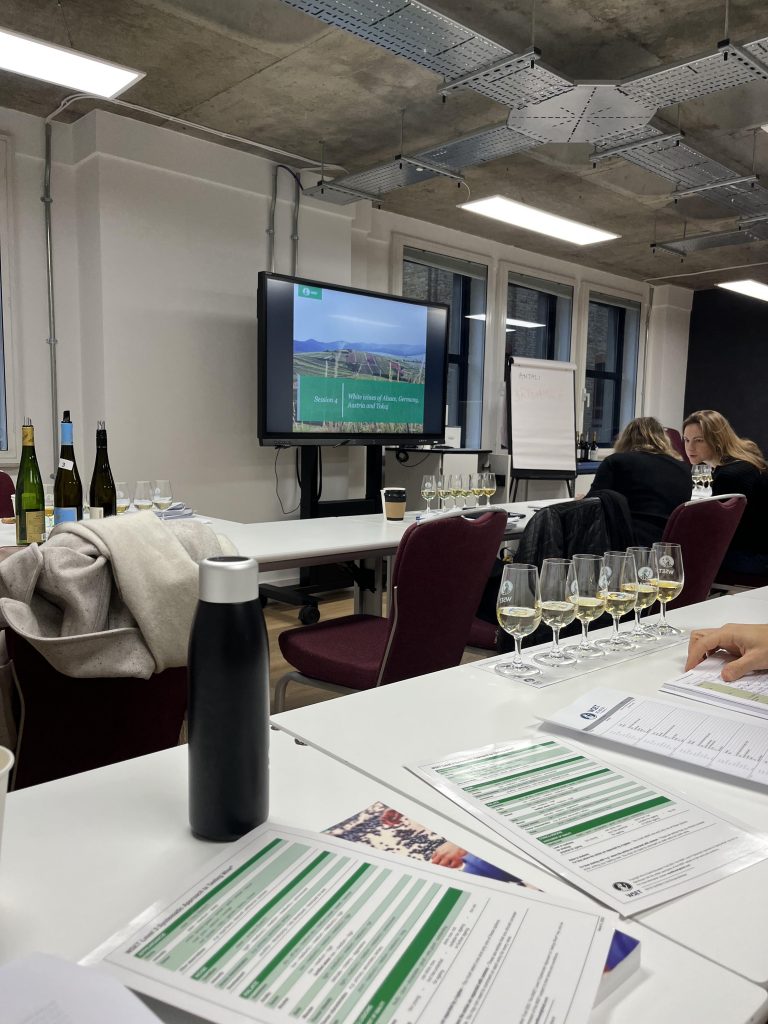
Although the 5-day course from 9 to 17 is extremely challenging, it is unfortunately the only suitable option especially for those coming from abroad for a short period.
Positive Comments
One of the best aspects of the education we received was that a different instructor came each day. Listening to similar topics from 5 different instructors over 5 days also allowed us to see different perspectives. Additionally, the fact that an observer instructor entered each class just to take notes on the main instructor's presentations throughout the entire day showed how much importance WSET London School places on education quality. Although there were points where the instructors occasionally contradicted each other, even this was actually one of the indicators of how deep and complex the wine world is. Compared to our previous education, having a single instructor means you only have the chance to gain knowledge from that one instructor's perspective, which can be somewhat more limiting compared to multiple instructors.
Perhaps the most successful part we found during the education was that the instructors were completely objective. Since England is a relatively new country in terms of winemaking, they can approach all other countries neutrally. We were glad not to experience the bit of French wine propaganda we had experienced in France 🙂 In fact, quite the opposite, we loved that they made plenty of references to the unnecessary wine elitism practiced by the French 🙂
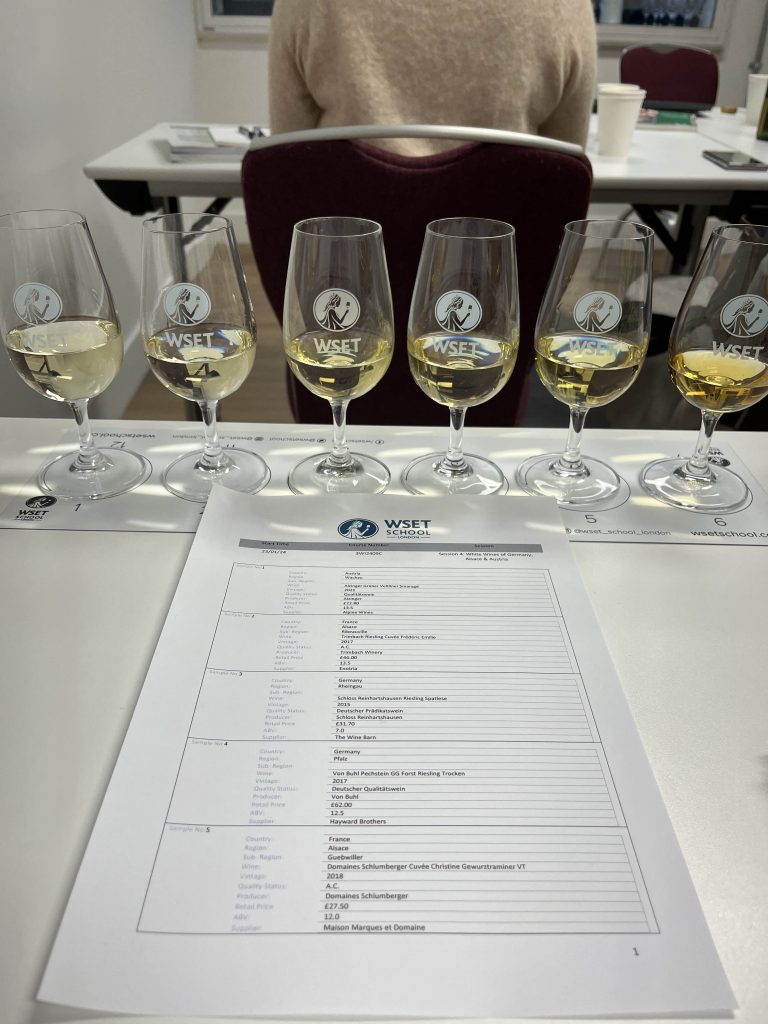
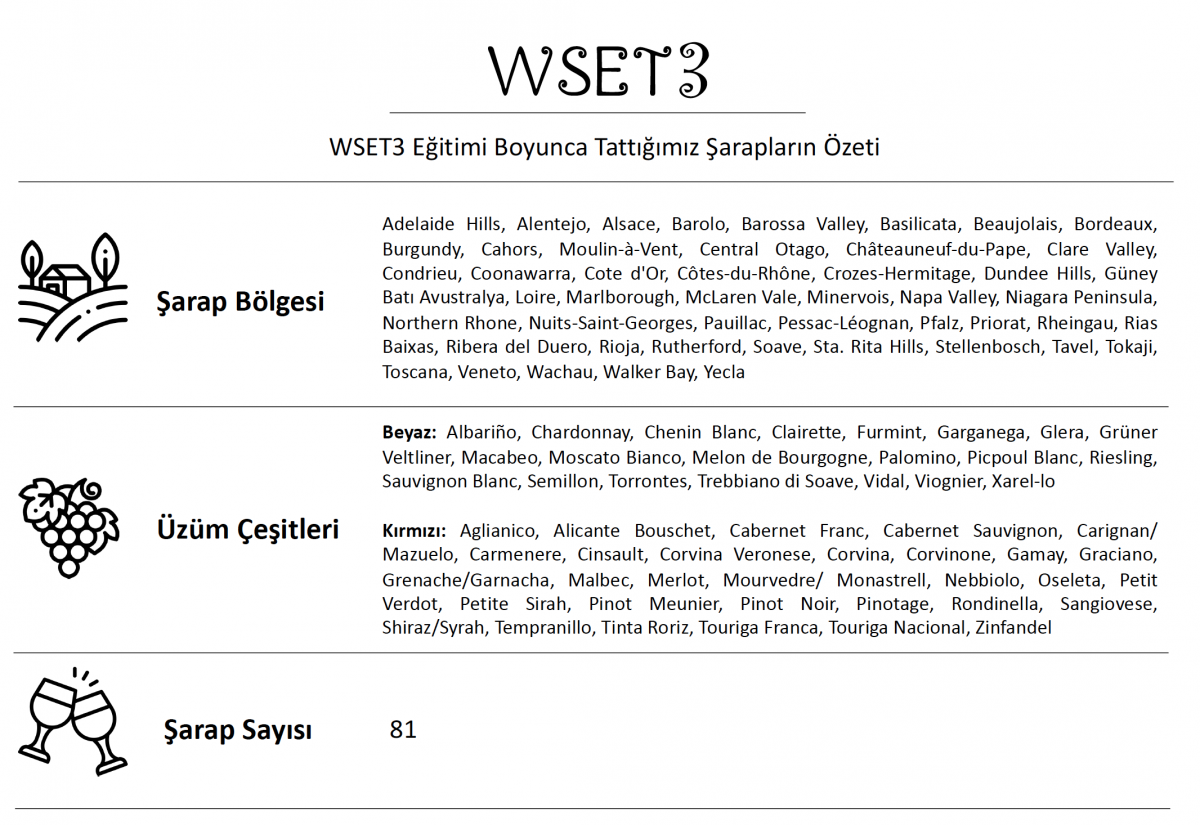
Another successful aspect of the education was the wines included in it. Drinking over 80 quality wines from different parts of the world back to back over 5 days was both a great opportunity to develop our palates and a true feast for our palates. We especially appreciated that the selected wines closely followed the course content. Almost none of the regions emphasized in the education were skipped. Particularly being able to taste 2 different similar examples from certain regions (such as an everyday Australian Shiraz vs. a premium Australian Shiraz) back to back was good for comparison and palate calibration purposes.
Negative Comments
In the WSET2 education we took in France, during a similarly intensive 3-day course, although we occasionally struggled with the nearly 20 wine tastings per day, we managed overall across the total course. However, for WSET3, due to both the course content being extremely intensive and the additional 2 days of wine tasting and education fatigue, we can say it totally wore us out 🙂 While we had been able to turn our evenings into a trip by exploring the city when we went to Paris for WSET2, in London we had to return to the hotel early and study nearly every evening.
Unfortunately, the educational content relies heavily on memorization. Especially in the tasting section, rather than making wine-specific comments, they evaluate and comment on wines based on the grapes they contain and the geography the wines come from, in order to better calibrate the students. The possibility that any given bottle might have matured differently than others is overlooked; wines that don't show the characteristics they should generally show can be interpreted differently simply because they come from a specific region. In the tasting sections, different possibilities can often be skipped entirely without being evaluated, or a very different or unusual aroma can be passed over directly without delving into its cause. Wines that might be interpreted very differently in a blind tasting can be praised simply because they come from a more expensive or prestigious region. To give an example, a cheap Australian Shiraz is defined as "Good" simply because it's simply made despite being a price/performance wine, while a Grand Cru from the Pauillac region is ultimately defined as "Exceptional" simply because it's a Grand Cru, despite the entire class feeling it didn't meet expectations.
The theoretical education part is covered very quickly in classroom sessions. It's nearly impossible for a student to pass the exam based solely on the lessons. Because of this, at least 40 to 50 hours of self-study before starting the course is stated as a requirement. Under normal circumstances, an education that does justice to all the topics in the book would need to last at least 9 to 10 full days. Considering this, the lessons move very fast relative to the educational content. Similarly, since WSET2 is a prerequisite, the topics covered there are skipped much more quickly in the classroom sessions. For this reason, if you have the time, it's beneficial to review the WSET2 course content again before the education.
Summary
In summary, although the 5-day consecutive course is an extremely challenging education, it develops the palate very well, especially in terms of tasting. The fact that no expense was spared in the selected wines particularly deserves appreciation.
Exam
The exam is considerably harder than WSET2. It consists of 3 stages in total and lasts approximately 3 hours.

Theory Multiple Choice: This section with 50 multiple choice questions is in the format we were familiar with from WSET2. As with WSET2, there are very simple questions alongside quite detailed ones. Since the passing score is 55%, this is the easiest part of the exam to pass.
Theory Written: The hardest part of the exam. The questions in this written section, consisting of 4 main questions, cover topics requiring very detailed knowledge. Very specific definitions are expected as answers. So there's no benefit in writing long answers by speculating and hoping for the best on a topic you're not sure about 🙂
Although it appears as 4 questions in total, each of these questions has 6 to 8 sub-parts. So in total there are 20 to 30 questions that need to be answered. To pass, you need to score 55% in this section independently of the other sections. The fact that the time for both theoretical parts is combined also makes time management quite important. Since the written part takes considerable time, the multiple choice part needs to be completed as quickly as possible.
Blind Tasting: In this exam where a total of 2 wines are tasted, 1 white and 1 red, the accuracy of analyses such as acidity, body, alcohol, tannin, and aroma profiles is tested. If the exam features a simple white and a complex red wine, you're very lucky, because distinguishing these is much easier. But especially if a simple but not particularly bad red wine comes up, then there's a chance of being completely wrong 🙂
During the tasting exam practice held on the 4th day of the education, after they placed 2 curveball wines resulting in half the class failing and the other half barely passing, we as a class started worrying deeply about the tasting exam. Following such a scare, we spent the evenings of our last 2 days doing plenty of wine tasting at wine bars. Following our instructors' advice, we also made sure to calibrate ourselves before the tasting exam by tasting what could be considered the simplest white (Pinot Grigio) and a red (one of France's cheapest blends). We definitely recommend this tactic, which we truly found beneficial, to anyone taking the exam.
Favorite Wines
Although we drank wines from completely different regions of the world throughout the education, we didn't neglect to make our favorites list so as not to do injustice to these wonderful wines we tried.
Our top 6 favorite wines were:
- Domaine de la Vieille Julienne, Les Trois Sources Châteauneuf-du-Pape, Grenache, 2016, Red, France, Châteauneuf-du-Pape: There are aromas on the nose and palate that can be defined in very different ways. Complex, concentrated, tertiary aromas are abundantly felt. Truly superb. 7.75
- Cillar de Silos, Torresilo Ribera del Duero, Tempranillo, 2020, Red, Spain, Ribera del Duero: A red and dark fruit combination on the nose and palate. Much better on the palate than on the nose. Tannins are velvety, high complexity. The finish is one of the longest of any wine we've tried. 7.70
- Glaetzer, Bishop Shiraz, 2020, Red, Australia, Barossa Valley: Dark fruits, licorice, black pepper on the nose. Very high aroma concentration on the palate. Oak comes from deep, integration is nice. Complex. Has the potential to develop more tertiary characteristics with aging. Should definitely be tried after aging. 7.60
- Disznókó, Tokaji Aszú 5 Puttonyos, Furmint, 2013, Sweet, Hungary, Tokaji: Complexity is superb. Very high aroma concentration. Apricot, baked apple, honey, everything is there. The intensity on the nose is top level. The sweetness level doesn't bother at all on the palate because it's balanced by the acidity, full-bodied with a long finish. 7.60
- E. Guigal, Côte-Rôtie Brune & Blonde de Guigal, Syrah, 2018, Red, France, Northern Rhône: The aroma concentration on the nose and palate is very nice. Although the tannins feel a bit angular, the potential is very high. We were very curious about how it would change after aging. It has a classic Syrah characteristic: dark fruits and spices, clove, black pepper, licorice. 7.60
- Cloudy Bay, Sauvignon Blanc, 2023, White, New Zealand, Marlborough: Full tropical fruits are dominant on the nose, passion fruit in particular is felt very intensely. High aroma intensity on the palate. Complex, clean, aromatic. A perfect wine to drink today. 7.55